

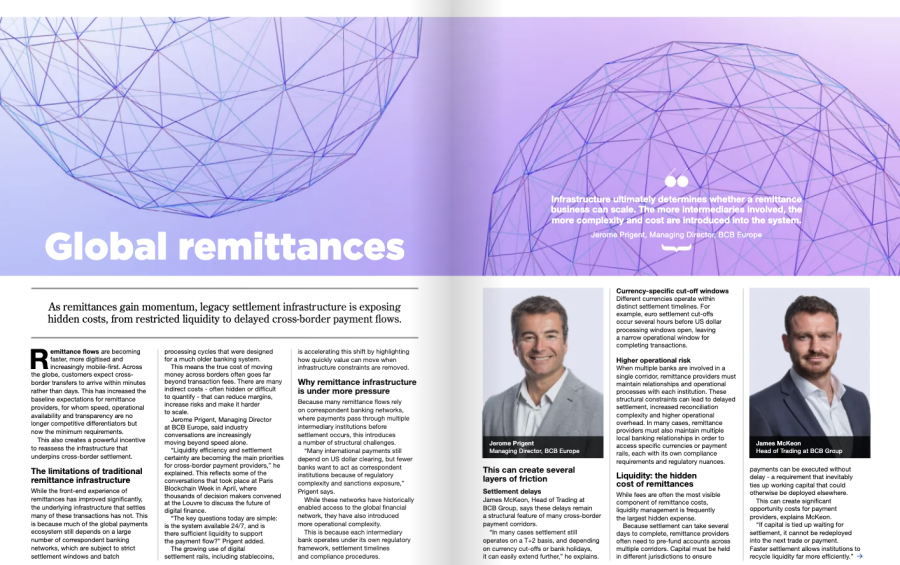
Global remittances: The hidden cost of legacy settlement infrastructure
The hidden cost of legacy settlement infrastructure
Remittance flows are becoming faster, more digitised and increasingly mobile-first. Across the globe, customers expect cross-border transfers to arrive within minutes rather than days. This has increased the baseline expectations for remittance providers, for whom speed, operational availability and transparency are no longer competitive differentiators but now the minimum requirements.
This also creates a powerful incentive to reassess the infrastructure that underpins cross-border settlement.
The limitations of traditional remittance infrastructure
While the front-end experience of remittances has improved significantly, the underlying infrastructure that settles many of these transactions has not. This is because much of the global payments ecosystem still depends on a large number of correspondent banking networks, which are subject to strict settlement windows and batch processing cycles that were designed for a much older banking system.
This means the true cost of moving money across borders often goes far beyond transaction fees. There are many indirect costs – often hidden or difficult to quantify – that can reduce margins, increase risks and make it harder to scale.
Jerome Prigent, Managing Director at BCB Europe, said industry conversations are increasingly moving beyond speed alone.
“Liquidity efficiency and settlement certainty are becoming the main priorities for cross-border payment providers,” he explained.
“The key questions today are simple: is the system available 24/7, and is there sufficient liquidity to support the payment flow?” Prigent added.
The growing use of digital settlement rails, including stablecoins, is accelerating this shift by highlighting how quickly value can move when infrastructure constraints are removed.
Why remittance infrastructure is under more pressure
Because many remittance flows rely on correspondent banking networks, where payments pass through multiple intermediary institutions before settlement occurs, this introduces a number of structural challenges.
“Many international payments still depend on US dollar clearing, but fewer banks want to act as correspondent institutions because of regulatory complexity and sanctions exposure,” Prigent says.
While these networks have historically enabled access to the global financial network, they have also introduced more operational complexity.
This is because each intermediary bank operates under its own regulatory framework, settlement timelines and compliance procedures.
This can create several layers of friction
Settlement delays
James McKeon, Head of Trading at BCB Group, says these delays remain a structural feature of many cross-border payment corridors.
“In many cases settlement still operates on a T+2 basis, and depending on currency cut-offs or bank holidays, it can easily extend further,” he explains.
Currency-specific cut-off windows
Different currencies operate within distinct settlement timelines. For example, euro settlement cut-offs occur several hours before US dollar processing windows open, leaving a narrow operational window for completing transactions.
Higher operational risk
When multiple banks are involved in a single corridor, remittance providers must maintain relationships and operational processes with each institution. These structural constraints can lead to delayed settlement, increased reconciliation complexity and higher operational overhead. In many cases, remittance providers must also maintain multiple local banking relationships in order to access specific currencies or payment rails, each with its own compliance requirements and regulatory nuances.
Liquidity: the hidden cost of remittances
While fees are often the most visible component of remittance costs, liquidity management is frequently the largest hidden expense.
Because settlement can take several days to complete, remittance providers often need to pre-fund accounts across multiple corridors. Capital must be held in different jurisdictions to ensure payments can be executed without delay – a requirement that inevitably ties up working capital that could otherwise be deployed elsewhere.
This can create significant opportunity costs for payment providers, explains McKeon.
“If capital is tied up waiting for settlement, it cannot be redeployed into the next trade or payment. Faster settlement allows institutions to recycle liquidity far more efficiently.”
For example, if a remittance provider initiates a cross-border trade that settles on a T+2 basis, the funds involved in that transaction cannot be redeployed until settlement is completed. This creates a significant liquidity risk for providers that process high volumes of transfers across multiple corridors. Many providers attempt to bridge this gap by maintaining prefunded accounts across multiple jurisdictions or by using credit facilities and liquidity buffers to ensure payments can be executed without delay. Short settlement windows and currency-specific processing timelines can also increase foreign exchange exposure, which only exacerbates the operational burdens.
What if settlement fails?
If settlement fails to occur within a defined window, transactions may roll to the next processing day, which can add more costs increase FX risk and result in a poor customer experience.
Liquidity fragmentation can complicate treasury management even further, especially for providers operating across multiple regions. They face the arduous task of monitoring capital balances across different accounts, currencies and counterparties – all while maintaining sufficient buffers to manage settlement delays.
This fragmented liquidity management can also create additional compliance and safeguarding complexity, particularly for regulated payment institutions that are obliged to demonstrate clear oversight of client funds across multiple jurisdictions.
As remittance volumes scale, these liquidity requirements can become an even bigger operational burden. In practice, many remittance providers are effectively acting as liquidity managers – balancing capital deployment across multiple payment corridors while navigating settlement cycles, regulatory requirements and FX exposure.
In emerging markets, where access to traditional banking infrastructure is often more limited, digital payment rails and mobile wallets are increasingly reshaping how the final stage of remittance delivery takes place.
This is why real-time payments need modern infrastructure
As Prigent puts it: “How can I accept receiving €1 in one minute and then have to wait two or three days to receive $10 million? It’s not sustainable.”
Corporate customers that are accustomed to instant domestic payments are increasingly unwilling to tolerate multi-day settlement cycles for international transfers. At the same time, fintech competitors and digital remittance platforms are pushing the industry toward faster service levels. However, this cannot be achieved by introducing incremental upgrades at the front-end: the underlying settlement infrastructure must be designed to support real-time processing.
In the last few years, the rapid adoption of digital settlement rails in some sectors of the payments ecosystem has already made this disparity even more visible, demonstrating how infrastructure design directly influences liquidity efficiency.
This highlights the growing gap between modern payment expectations and the legacy infrastructure that still supports many cross-border transfers.
Therefore, industry conversations must move away from speed alone and toward broader questions of settlement certainty and liquidity efficiency.
Turning infrastructure into a competitive advantage
As the remittance industry evolves, infrastructure is becoming a critical determinant of operational resilience and scalability.
“Infrastructure ultimately determines whether a remittance business can scale,” says Prigent. “The more intermediaries involved, the more complexity and cost are introduced into the system.”
Real-time settlement networks offer one potential path forward. By enabling instant transfers between participating institutions, these networks can reduce settlement cycles from days to seconds.
“Within a network environment, transactions can settle instantly rather than waiting for traditional settlement cycles,” says McKeon.
This shift can have several implications for remittance providers:
- Improved liquidity utilisation. Faster settlement allows capital to be redeployed more quickly rather than remaining tied up in pending transactions. Several BLINC clients have reported that instant settlement significantly improves capital efficiency by allowing liquidity to be recycled across multiple transactions in real time.
- Reduced operational complexity. Direct settlement within a network can reduce reliance on multiple correspondent banking relationships.
- Greater predictability. Real-time processing can improve transparency and reduce the risk of settlement delays caused by cut-off windows or intermediary processing.
BCB Group’s BLINC network is designed to address these challenges by enabling real-time settlement between participants across multiple currencies.
Within the network, transactions can settle instantly rather than following traditional T+2 settlement cycles. This allows institutions operating within the ecosystem to move funds without waiting for traditional banking windows to open.
For remittance providers, the implications are significant. Faster settlement improves capital efficiency, reduces liquidity fragmentation and allows payment flows to operate continuously rather than within defined banking hours.
As the number of participants within a network grows, liquidity within the system can also increase, enabling more efficient movement of funds between institutions.
Importantly, however, increased participation does not eliminate counterparty risk. Each transaction still occurs between individual institutions, and risk management remains an essential component of payment operations. For payment providers operating across multiple jurisdictions, settlement infrastructure is therefore becoming a strategic component of treasury management rather than simply a back-end operational function.
The next generation of remittance infrastructure
As cross-border payments continue to evolve, the future of remittances will likely be defined not only by transaction speed but by how efficiently capital moves through the system.
Prigent believes the next phase of payment infrastructure will focus on bridging traditional financial systems with digital settlement networks.
“Providing a regulated, reliable, real-time platform that connects fiat systems with digital assets is becoming a key priority,” he says.
For institutional payment providers, the key question is no longer how quickly funds can reach a recipient. Instead, attention is shifting toward how settlement infrastructure affects liquidity utilisation, operational resilience and the ability to scale globally.
The remittance sector operates within a highly competitive environment where margins are often thin and regulatory requirements are increasing. Infrastructure decisions can therefore have a direct impact on profitability and operational risk.
In this context, settlement speed, liquidity efficiency and transparency are becoming essential components of modern payment infrastructure.
As the industry moves toward a 24/7/365 payments environment, infrastructure capable of supporting real-time settlement and continuous liquidity management will increasingly shape how global remittance flows operate.
For providers evaluating their technology stack, the challenge is not simply adopting faster payment interfaces. It is ensuring that the underlying infrastructure supports the operational realities of modern cross-border payments – including continuous settlement, predictable liquidity management and scalable global payment flows.
Because in global remittances, the real cost of moving money is often not the transaction fee itself — but the liquidity trapped in the systems that move it.
Read the full magazine here

Related Insights

How Banks Are Navigating the Correspondent Banking Transition in 2026
READ
Beyond the Hype: Why x402 and Agentic Commerce Fix the 30-Year Micropayment Problem
READ
BCB Group CTO Armin Ranjbar on finding the right unit of progress
READ
Young People and Cryptocurrency: What the Next Generation Really Thinks About Digital Finance
READ
BCB Group is shortlisted for four awards at the Women in Tech Employer Awards 2026
READ
BCB Group on the importance of remittances within the financial ecosystem
READ
The Fintech Times Coverage of BCB Groups award win
READ