

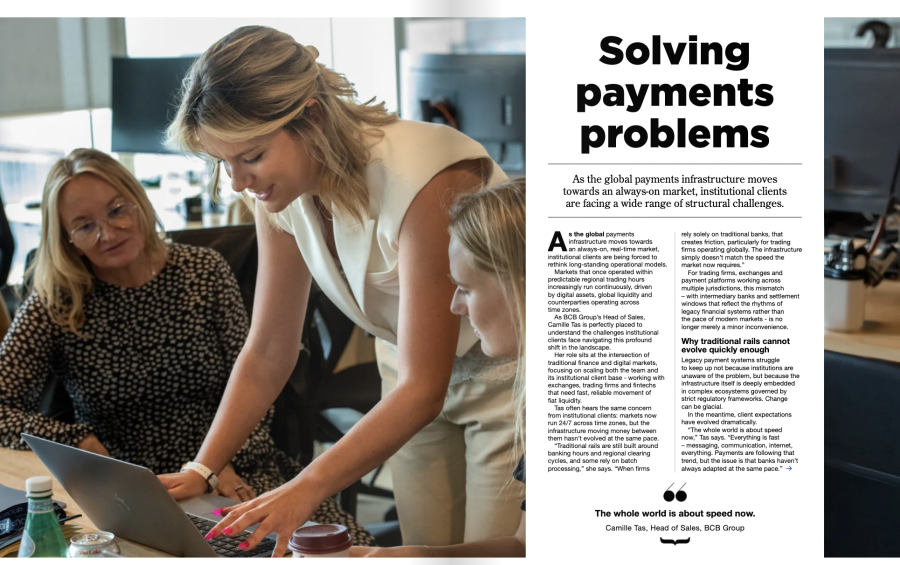
Solving Payments Problems
As the global payments infrastructure moves towards an always-on, real-time market, institutional clients are being forced to rethink long-standing operational models.
Markets that once operated within predictable regional trading hours increasingly run continuously, driven by digital assets, global liquidity and counterparties operating across time zones.
As BCB Group’s Head of Sales, Camille Tas is perfectly placed to understand the challenges institutional clients face navigating this profound shift in the landscape. Her role sits at the intersection of traditional finance and digital markets, focusing on scaling both the team and its institutional client base – working with exchanges, trading firms and fintechs that need fast, reliable movement of fiat liquidity.
Tas often hears the same concern from institutional clients: markets now run 24/7 across time zones, but the infrastructure moving money between them hasn’t evolved at the same pace.
“Traditional rails are still built around banking hours and regional clearing cycles, and some rely on batch processing,” she says. “When firms rely solely on traditional banks, that creates friction, particularly for trading firms operating globally. The infrastructure simply doesn’t match the speed the market now requires.”
For trading firms, exchanges and payment platforms working across multiple jurisdictions, this mismatch – with intermediary banks and settlement windows that reflect the rhythms of legacy financial systems rather than the pace of modern markets – is no longer merely a minor inconvenience.
Why traditional rails cannot evolve quickly enough
Legacy payment systems struggle to keep up not because institutions are unaware of the problem, but because the infrastructure itself is deeply embedded in complex ecosystems governed by strict regulatory frameworks. Change can be glacial.
In the meantime, client expectations have evolved dramatically.
“The whole world is about speed now,” Tas says. “Everything is fast – messaging, communication, internet, everything. Payments are following that trend, but the issue is that banks haven’t always adapted at the same pace.”
“Clients expect fast service and a strong customer experience, and they expect to see the results of their trades and transactions almost instantly,” Tas explains. “Today you can send a message to the other side of the world, and it arrives immediately. There are no letters anymore that take two weeks!”
Institutional clients increasingly expect the same immediacy in financial operations that they experience in digital communication and other online services.
But while information now moves instantly, capital often does not. Settlement speed is directly tied to liquidity, risk management and operational resilience. So, when funds cannot move quickly enough, firms have to compensate elsewhere in their balance sheet.
“In many cases, institutions need to hold their own liquidity and take that risk themselves,” Tas says. “They keep funds available in different markets so they can operate while settlements happen.”
However, where firms can’t maintain large reserves, settlement delays affect customers directly. “If they don’t have that liquidity, then their clients might have to wait a few days to receive funds,” Tas explains. “Reputationally that’s difficult, because clients may move somewhere else afterwards.”
Increasingly, institutions are recognising that incremental improvements to legacy systems are not enough.
What institutions need most
Put simply, institutions need infrastructure built specifically for institutional markets – solutions that operate continuously, move funds instantly, support multiple currencies and remain fully compliant with regulatory standards.
BCB Group’s “safety from day one” philosophy reflects its commitment to regulatory-first principles and institutional-grade infrastructure. But what exactly does ‘institutional grade’ mean in practice?
“It essentially means the infrastructure is built for institutions,” Tas says. “The network is used by institutional participants, and it’s designed to handle secure, high-value transactions within that environment.”
Speed is only one part of the equation. Reliability, regulatory alignment and transparency matter just as much, yet some misconceptions about instant settlement remain.
“Even traditional banking services have fees attached, so if a service is faster or better, people often expect it to be more expensive,” Tas says.
Some also assume that because transactions move so quickly, instant settlement carries greater risk or less oversight. In reality, Tas explains, it often does the opposite.
“It reduces the risk of losing clients, the risk of dissatisfaction, and even the risk of funds being stuck for too long,” she explains.
When funds move instantly between trusted counterparties, institutions gain clearer visibility over liquidity and exposure. Settlement risk decreases because transactions complete immediately rather than waiting hours or days for confirmation.
Through its work with exchanges, liquidity providers and fintechs, the team at BCB Group noticed a clear pattern: firms transact with each other constantly, yet payments between them still rely on slow external banking rails.
Finding the solutions in the BLINC of an eye
From Tas’s perspective working with institutions, how can they approach payments in a more strategic way?
“Most institutions already work with multiple providers because of different risk appetites and onboarding requirements. They also separate operational accounts from client-facing accounts and segregate payment flows,” she says.
“But they can take a more strategic approach by ensuring their different teams and entities are aligned. Large institutions often have multiple teams and legal entities, so it helps if they use the same providers, the same flows, and ideally the same settlement network. That makes it easier to balance funds between different treasuries across the organisation.”
BLINC addresses this by creating a closed institutional network where all participants undergo extensive compliance checks before joining. Once onboarded, members can transfer funds instantly within the network.
“There’s a lengthy compliance process beforehand,” Tas says. “But once you’re in and everything is verified, the instant settlements happen within the same network.”
This structure removes many of the delays associated with traditional payment rails. Transfers no longer depend on correspondent banks, clearing cycles or limited operating hours.
“They know payments won’t be held by a bank for extra checks,” Tas says. “They arrive when expected – even over the weekend or outside banking hours.”
So how would Tas explain BLINC to someone who was hearing about it for the first time?
“BLINC is an instant settlement network that we created after working in this space since 2017. We work with many of the larger players in the market and know that they all interact with each other regularly,” Tas explains. “The problem we’re solving is enabling instant settlement between these participants while maintaining security and reliability.”
“We’ve seen many examples of where we’ve helped clients improve operational and settlement timeframes at scale, enhancing their capital efficiency with better liquidity management and improving their customer satisfaction,” she adds.
“With traditional banks, you might receive a request for information (RFI) and the payment could be held for a day or two,” Tas explains. “That can bring operations down for that transaction.”
Because BLINC participants are pre-approved within a trusted network, those interruptions largely disappear, enabling firms to maintain uninterrupted trading and settlement activity.
“For firms working with liquidity providers, it can also be very cost-effective because high transaction volumes would otherwise generate significant bank transfer fees.”
“When institutions can move funds instantly, they don’t need to hold as much liquidity in different places,” Tas explains. Instead, treasury teams can shift funds precisely when required, improving capital efficiency and reducing the cost of maintaining idle balances.
Regulatory strength as a competitive advantage
While boosting speed and efficiency are essential, trust and regulatory alignment are arguably just as crucial for building credibility with institutional clients and counterparties.
Compliance frameworks demonstrate that an organisation operates according to recognised standards and maintains robust governance procedures.
“They show the standards of compliance that you have,” she explains. “That creates trust with clients and partners and allows them to scale their operations with confidence.”
Rather than hindering innovation, regulatory strength can therefore become a competitive advantage. Firms capable of balancing technological progress with rigorous governance often gain greater institutional adoption.
Find the solution: support growth
Solving payments challenges does more than improve operational efficiency. It can be a key strategic enabler to unlock growth, pave the way for international expansion and develop new financial services.
“Solving payments infrastructure issues helps companies expand more easily into new jurisdictions and markets,” Tas says. “They can settle quickly and move liquidity more easily, which gives them a strategic advantage.”
The implications are especially significant in digital asset markets, where stablecoins, crypto trading and multi-asset platforms operate continuously across global markets.
Tas also highlights the increasing demand for BLINC’s services from emerging markets with unstable local currencies, where stablecoins work quietly in the background to help move money faster and more cheaply, in particular for families and small businesses who need reliable access to money across borders.
There’s also a growing demand for cross-border financial services beyond simply sending wages home – from paying mortgages and school fees to purchasing insurance products directly.
“We’re working more with remittance companies and organisations in emerging markets because instant settlement is extremely important for those use cases,” she notes. “In regions such as Latin America and Africa, we’re seeing strong interest on a daily basis.”
As adoption grows, each new participant to the BLINC network expands the ecosystem, increasing the number of counterparties capable of settling instantly within the network.
The future of institutional settlement
With financial markets moving steadily towards 24/7/365 operating models, expectations around institutional settlement are evolving just as quickly.
As Tas explains, “As payments infrastructure becomes more always-on, it will impact trading, treasury, and custody workflows as well. Institutions will expect payments to move as seamlessly as data does today – instantly and across different assets.”
That shift is bringing modern technologies into the conversation, particularly artificial intelligence (AI) and advanced data capabilities.
“Conferences I visit are increasingly bringing together crypto, payments and AI because they work hand in hand. AI will be embedded not just in daily workflows but also in the infrastructure itself,” Tas says.
The basis for this transformation is the growing strategic importance of data.
“For example, for us in the Sales team, data allows us to identify patterns, understand client behaviour, and improve areas such as fraud detection,” Tas explains. “AI relies on data to function effectively, so the more data we can analyse, the better decisions we can make.”
In the future, institutions will expect capital to move with the same immediacy as data.
“Institutions will expect payments to move as seamlessly as data – instantly and across different assets,” she explains.
And if institutions don’t modernise their payments infrastructure?
“If they continue relying on legacy settlement systems and traditional banks, they risk operating with higher costs, slower liquidity movement, and increasing operational complexity,” she warns.
“As markets move toward real-time global infrastructure, institutions that stay with older systems will fall behind and face a strategic disadvantage compared to those adopting modern settlement networks.”
The world of global digital payment markets is increasingly one that doesn’t sleep – and you don’t have to be Sherlock Holmes to see that adopting modern settlement networks is the solution staring institutional clients in the face.
Read the full BLINC magazine here
Talk to BCB
Get in touch with our team to discover how BCB’s institutional-grade infrastructure can help solve payment problems.

Related Insights
Beyond the Hype: Why x402 and Agentic Commerce Fix the 30-Year Micropayment Problem
READ
BCB Group CTO Armin Ranjbar on finding the right unit of progress
READ
Young People and Cryptocurrency: What the Next Generation Really Thinks About Digital Finance
READ
BCB Group is shortlisted for four awards at the Women in Tech Employer Awards 2026
READ
BCB Group on the importance of remittances within the financial ecosystem
READ
The Fintech Times Coverage of BCB Groups award win
READ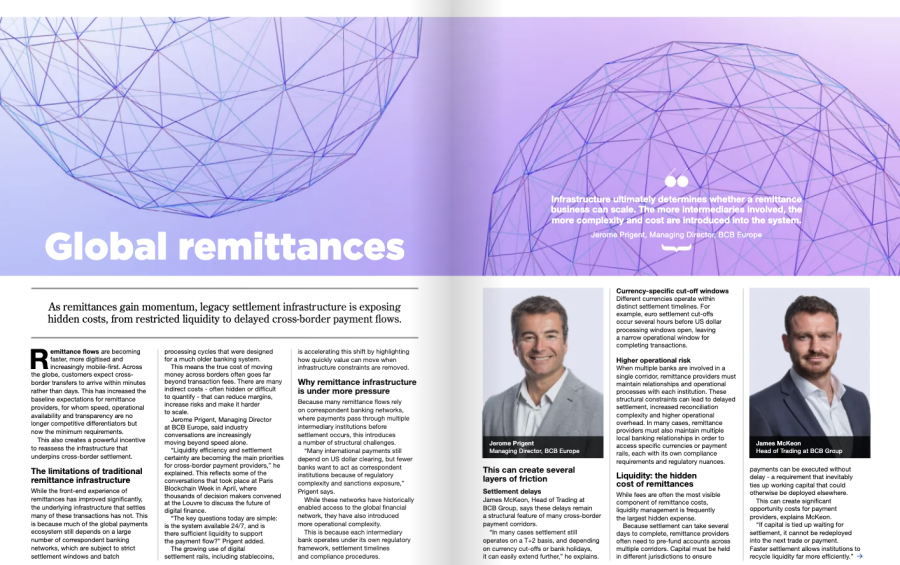
Global remittances: The hidden cost of legacy settlement infrastructure
READ