
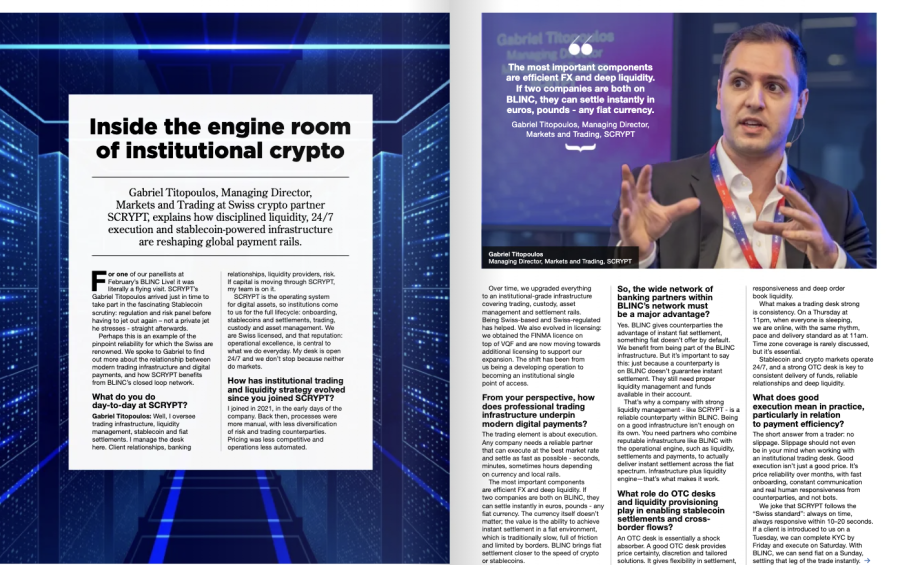
Inside the engine room of institutional crypto with Gabriel Titopoulos
Gabriel Titopoulos, Managing Director, Markets and Trading at Swiss crypto partner SCRYPT, explains how disciplined liquidity, 24/7 execution and stablecoin‑powered infrastructure are reshaping global payment rails.
For one of our panellists at February’s BLINC Live! it was literally a flying visit. SCRYPT’s Gabriel Titopoulos arrived just in time to take part in the fascinating Stablecoin scrutiny: regulation and risk panel before having to jet out again – not a private jet he stresses – straight afterwards.
Perhaps this is an example of the pinpoint reliability for which the Swiss are renowned. We spoke to Gabriel to find out more about the relationship between modern trading infrastructure and digital payments, and how SCRYPT benefits from BLINC’s closed loop network.
What do you do day to day at SCRYPT?
Gabriel Titopoulos: Well, I oversee trading infrastructure, liquidity management, stablecoin and fiat settlements. I manage the desk here. Client relationships, banking relationships, liquidity providers, risk. If capital is moving through SCRYPT, my team is on it.
SCRYPT is the operating system for digital assets, so institutions come to us for the full lifecycle: onboarding, stablecoins and settlements, trading, custody and asset management. We are Swiss-licensed, and that reputation for operational excellence is central to what we do every day. My desk is open 24/7 and we don’t stop, because neither do markets.
How has institutional trading and liquidity strategy evolved since you joined SCRYPT?
I joined in 2021, in the early days of the company. Back then, processes were more manual, with less diversification of risk and trading counterparties. Pricing was less competitive and operations less automated.
Over time, we upgraded everything to an institutional-grade infrastructure covering trading, custody, asset management and settlement rails. Being Swiss-based and Swiss-regulated has helped. We also evolved in licensing: we obtained the FINMA licence on top of VQF and are now moving towards additional licensing to support our expansion. The shift has been from us being a developing operation to becoming an institutional single point of access.
From your perspective, how does professional trading infrastructure underpin modern digital payments?
The trading element is about execution. Any company needs a reliable partner that can execute at the best market rate and settle as fast as possible – seconds, minutes, sometimes hours depending on currency and local rails.
The most important components are efficient FX and deep liquidity. If two companies are both on BLINC, they can settle instantly in euros, pounds – any fiat currency. The currency itself doesn’t matter; the value is the ability to achieve instant settlement in a fiat environment, which is traditionally slow, full of friction and limited by borders. BLINC brings fiat settlement closer to the speed of crypto or stablecoins.
So, the wide network of banking partners within BLINC’s network must be a major advantage?
Yes. BLINC gives counterparties the advantage of instant fiat settlement, something fiat doesn’t offer by default. We benefit from being part of the BLINC infrastructure. But it’s important to say this: just because a counterparty is on BLINC doesn’t guarantee instant settlement. They still need proper liquidity management and funds available in their account.
That’s why a company with strong liquidity management – like SCRYPT – is a reliable counterparty within BLINC. Being on a good infrastructure isn’t enough on its own. You need partners who combine reputable infrastructure like BLINC with the operational engine, such as liquidity, settlements and payments, to actually deliver instant settlement across the fiat spectrum. Infrastructure plus liquidity engine—that’s what makes it work.
What role do OTC desks and liquidity provisioning play in enabling stablecoin settlements and cross-border flows?
An OTC desk is essentially a shock absorber. A good OTC desk provides price certainty, discretion and tailored solutions. It gives flexibility in settlement, responsiveness and deep order book liquidity.
What makes a trading desk strong is consistency. On a Thursday at 11pm, when everyone is sleeping, we are online, with the same rhythm, pace and delivery standard as at 11am. Time zone coverage is rarely discussed, but it’s essential.
Stablecoin and crypto markets operate 24/7, and a strong OTC desk is key to consistent delivery of funds, reliable relationships and deep liquidity.
What does good execution mean in practice, particularly in relation to payment efficiency?
The short answer from a trader: no slippage. Slippage should not even be in your mind when working with an institutional trading desk. Good execution isn’t just a good price. It’s price reliability over months, with fast onboarding, constant communication and real human responsiveness from counterparties, and not bots.
We joke that SCRYPT follows the “Swiss standard”: always on time, always responsive within 10–20 seconds. If a client is introduced to us on a Tuesday, we can complete KYC by Friday and execute on Saturday. With BLINC, we can send fiat on a Sunday, settling that leg of the trade instantly.
How has the perception of crypto markets among traditional finance institutions changed?
Dramatically. Two years ago, the conversation used to be “let’s explore this.” Now it’s “how do we scale this?” or “We launched with a low-quality provider, but now we need a full institutional package.”
The biggest shock for TradFi has been settlement speed. They see how fast it is and want to scale. Stablecoins and crypto rails open corridors where they previously had no local markets or settlement capability.
Where does friction still exist in payment corridors?
The main friction is local market liquidity, such as central banks, local market makers or currency conversion limitations.
If a local currency cannot be easily converted into dollars or euros, stablecoins become the bridge. If moving money out of a country with traditional markets takes three or four days, with stablecoins, this can be completed the same day or even instantly.
Liquidity is essential to reducing friction. Over the next five to ten years, regions like Africa will transform. Millions of people need to transact abroad for commodities, remittances and goods but they lack access to TradFi. That’s why stablecoin infrastructure will reshape FX in these corridors. Large FX desks in Asia and Africa are already building stablecoin capabilities and need partners like SCRYPT to fill the gap.
Let’s talk compliance. What does disciplined risk management look like in a modern trading desk?
There’s a perception – outside the industry – that crypto companies are unregulated and risk-free. That’s of course not true. We are licensed and operate in a regulatory framework just like traditional financial institutions, and regulation is evolving daily in Europe, the UK and the US.
Risk management is more important than ROI. You need proper mechanisms such as Travel Rule compliance, transaction monitoring, security systems and exposure management.
For example, many crypto trades are on chat infrastructures, which can be vulnerable to hacking. What happens if someone compromises your account? How is that risk mitigated? These are real operational risks that must be addressed from day one.
Another example is exposure limits across banks and counterparties. At SCRYPT, we built institutional standards from the beginning – structured reporting, exposure limits, real-time monitoring, and a strong compliance team. We’d seen the failures, and the common issue was weak risk management. Foundations matter – if you’ve built them correctly, new regulation will not be disruptive.
As regulation increases, where are the opportunities for growth? What needs to happen for digital asset payments to feel as easy as traditional FX?
If you build your company to institutional standards from day one, new regulation won’t disrupt you, you adapt. Companies without that foundation will need full restructuring.
With digital payments, I’d say that institutionally we’re not fully there across all markets. Maybe in G5 currencies we’re close, but in many local currencies the gap is still there – and that’s where the opportunity lies.
Retail adoption is another story. In mature markets like the UK, adoption is low because traditional rails already work well. But millions of people in the UK transact with countries outside it, which makes it a major opportunity for stablecoin-based payments.
We’re already active in many regions, but we’re expanding to continue building scalable, reputable and disciplined infrastructure globally. That’s where the future lies.
Read the full magazine here

Related Insights
How Banks Are Navigating the Correspondent Banking Transition in 2026
READ
Beyond the Hype: Why x402 and Agentic Commerce Fix the 30-Year Micropayment Problem
READ
BCB Group CTO Armin Ranjbar on finding the right unit of progress
READ
Young People and Cryptocurrency: What the Next Generation Really Thinks About Digital Finance
READ
BCB Group is shortlisted for four awards at the Women in Tech Employer Awards 2026
READ
BCB Group on the importance of remittances within the financial ecosystem
READ
The Fintech Times Coverage of BCB Groups award win
READ