


Hear from who we work with
“As a global cryptocurrency exchange, operational efficiency and reliable payment rails are absolutely critical to our success and, most importantly, our client satisfaction. Our integration with BCB Group’s BLINC Network has delivered transformative improvements to our institutional offering.
The BLINC network is a vital piece of infrastructure that strengthens the bridge between crypto and traditional finance. We are extremely satisfied with the product, highly value our partnership with BCB Group, and confidently recommend BLINC to any institutional player seeking superior settlement efficiency.”
Bitstamp
Business Development Team

“With BLINC we are able to speed up our settlement processes massively.
We can now provide better services to our clients and clear transactions with our connected LP and customers instantly 24/7/365.”
Roger Wurzel
Head of DLT Finance Group

“Since SDM started using BLINC, moving funds to our counterparties has become instant.
It’s not only faster but cheaper too, a big win for our daily operations.”
Curtis Bonebrake
Director, Finance Operations & Trade Settlement

“BLINC has been a reliable and efficient settlement solution for our operations, especially across counterparties within the BCB network
Transactions are processed instantly, which simplifies and improves liquidity handling between partners.
From a treasury perspective, it’s a reliable tool for executing same-day transfers without relying on traditional banking rails.”
Business Development Team

“BlockFills and BCB have a very similar outlook. We both believe that if we can set people up in a comfortable and stable digital ecosystem and build those rails together, the sky is the limit.
We’re very encouraged by what BCB is doing and has been doing for a very long time, because they have been very consistent in what they offer. Our hope is to continue to find ways to build that ecosystem together.”
Neil Huus
Chief Strategy Officer

“We’re focused on deep collaborations with partners who share our values—governance, regulation and resilience aren’t optional, they’re foundational.
That’s why we work with firms like BCB and other marquee names. We’re not chasing short-term wins, we’re building processes and relationships that support long-term trust. Transparency and auditability matter. We want Bitvavo to be Europe’s trusted gateway to crypto—and that means aligning with partners who are in it for the long haul.”
Audris Siow
Head of Institutional Partnerships

“BLINC has been instrumental in enabling Bitvavo to offer institutional clients and liquidity providers seamless 24/7 fiat on- and off-ramping. Its reliability and speed have become essential to our operational efficiency.”
Bart Verouden
Treasury Manager
“BCB enables us to settle high volume transfers for our customers and work with other trading desks through BLINC.
BCB helps us to transact billions of dollars, not least by providing the last mile of transaction into the US.”
Bernardo Brites
CEO and Co-founder

“The BCB BLINC Network has transformed our ability to move funds and process settlements for our client counterparties, driving instant and reliable payments for some of the largest digital asset-native institutions.
The speed and transparency it delivers have unlocked new efficiencies and scalability for Stillman Digital and our clients.”
Jonathon Milks
CEO

“It’s quick, seamless, and highly efficient. BLINC has made our settlement process effortless”
James Owens, Deus X Pay
Trade Operations

“Clients are seeking straightforward and secure solutions at a time when interest in stablecoins and on-chain finance is at an all-time high. This partnership with BCB Group illustrates the power of integrated systems and showcases the maturity of the market.”
Ben Lorente
Strategic Alliances Director

“Working with BCB Group has enabled BlockFills to deliver streamlined payment solutions to our clients, speeding up transactions as well as on and off-boarding between crypto and fiat.”
“We have also increased our own operational efficiencies through multiple currency accounts and virtual IBANs.”
Nick Hammer
BlockFills Co-founder and CEO
“We are thrilled to collaborate with BCB Group to provide an institutional-grade custody platform, enabling BCB Group to scale digital asset services for clients, while maintaining superior regulatory compliance and security standards.
A secure and versatile custody infrastructure is foundational to scaling business models in the digital asset economy while being able to promptly comply with existing or yet-to-come regulatory requirements across the globe.”
Aaron Sears
SVP of Global Partner and Customer Success at Ripple

“We’re happy to collaborate with BCB Group, demonstrating our commitment to providing best-in-class settlement capabilities and supporting the broader market’s growth and resilience.”
Massimo Di Placido
Group CFO of B2C2

“BCB’s cutting-edge settlement technology allows us to broaden our fiat currency offerings and deliver the speed and efficiency our clients need to thrive in the fast-paced and evolving global economy.”
Richard Crook
Deus X Pay CEO
“Thanks to BCB, counterparties we trade with benefit from fast and reliable settlement via the BLINC network, which is an outstanding example of innovation and critical problem-solving in the space. BCB is our trusted banking and payments partner and a critical part of the ecosystem for any firm in the crypto economy.”
Jason Stone
COO, Wintermute

“Integrating with BCB Group will greatly expand the fiat on- and off-ramps for businesses using Fireblocks by removing friction and allowing organizations globally to build localized products and services for millions of consumers.”
Ran Goldi
SVP Payments and Networks, Fireblocks

“With BCB, our clients benefit from fast and reliable settlement on fiat transfers. In addition, their BLINC network is a prime example of innovation in the space, where counterparties benefit from instant and free transfers between each other.
For Scrypt, this supercharges our trading ecosystem and helps us and our clients capture otherwise missed opportunities. Unlike traditional banks, when in comes to digital assets, BCB are putting their clients first.”
Norman Wooding
Scrypt Founder and CEO

“BCB is an innovative and fast-moving financial services firm that has been at the leading edge of trends shaping the future of the digital assets sector.
With institutional demand for digital dollar stablecoins growing rapidly around the world, BCB’s introduction of USDC services will provide clients with a critical piece of market infrastructure that is helping drive significant growth in crypto capital markets.”
Jeremy Allaire
Circle Co-founder and CEO


Built for growing financial businesses
Who uses BCB’s Virtual IBANs?
- Financial institutions
- Payment providers
- Fintechs
- Cross-border businesses
- Remittance businesses
- Asset managers
- Marketplaces
- Foreign exchange providers
- International trading businesses
- Digital asset firms

-

Compliance and anti-money laundering challenges are reduced, through clear segregation and improved transparency of funds.
-

Our vIBANs cut costs and complexity, giving businesses time back to focus on strategic goals and other vital corporate tasks.
-

Enhancement of security through account privacy and reduction of manual processing.
-
Reduce risk
Compliance and anti-money laundering challenges are reduced, through clear segregation and improved transparency of funds.
-
Cut costs
Our vIBANs cut costs and complexity, giving businesses time back to focus on strategic goals and other vital corporate tasks.
-
Secure
Enhancement of security through account privacy and reduction of manual processing.
Contact us
To learn more about how Virtual IBANs can simplify your organisation’s payment operations, speak to one of BCB Group’s specialists.
We’ll explain how Virtual IBANs integrate with your payment accounts, support international collections, improve reconciliation and strengthen treasury operations as your organisation grows.
FAQs
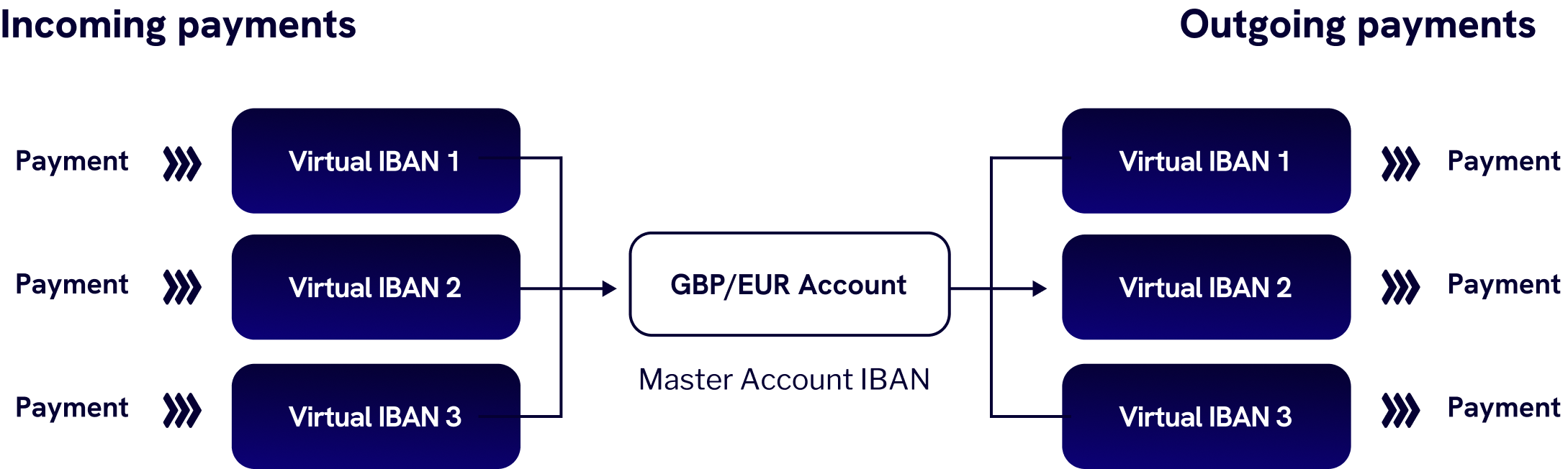
- What is a virtual IBAN?A virtual IBAN, or vIBAN, is a unique account identifier used to route payments into and out of an underlying account. It looks and functions like a regular IBAN to external banks and payment providers, but it does not hold a balance itself. Instead, it acts as a dedicated payment route linked to your main account, helping you identify customers, improve reconciliation and deliver a smoother payment experience.
- How do virtual IBANs work?Everything operates primarily through our API. Here is the standard flow:
- Creation: You use our API to request a virtual account within your account and assign it a specific name (e.g., your customer's name). You then share these bank details with your payer.
- Receiving Funds: When a deposit is made into the virtual IBAN, the funds actually credit your main account balance. You receive a notification of the deposit along with virtual IBAN details, making it easy to reconcile who the payment came from.
- Paying Out: You state the beneficiary details for the person associated with the virtual IBAN, and request to route funds out. This debits your main account, but the payout comes from the virtual IBAN.
- What are the main benefits of using virtual IBANs?Virtual IBANs vastly improve both your internal reconciliation and your customer’s experience:
- Automated Reconciliation: Easily identify exactly who is paying you without relying on reference fields.
- Improved Customer Experience: Customers can pay into, and receive payouts from an account in their own name, rather than your business's name.
- First-Party Transactions: Because the account is in the user's name, it appears as a first-party transaction to the sending/receiving bank, reducing friction.
- Familiar Capabilities: Virtual accounts (available in GBP and EUR) share the same payment capabilities as your account.
- How are virtual IBANs different from traditional IBANs?Externally, they are indistinguishable. To a sending or receiving bank, a virtual IBAN looks and functions exactly like a traditional IBAN.
Internally within the BCB system, the main difference is that virtual IBANs do not hold balances. They are simply a routing and segmentation method tied to your account, designed to improve the accuracy of reconciliation and allow you to name the virtual IBAN after your client. - Who should use virtual IBANs?Virtual IBANs are well suited to businesses managing high payment volumes across multiple counterparties. This includes cross-border firms such as ecommerce platforms, import/export businesses, foreign exchange providers and international property companies. They are particularly valuable where accurate allocation of client funds and efficient reconciliation are critical.
- Can I create a virtual IBAN for each customer?Yes. BCB enables the creation of an unlimited number of virtual IBANs under a single account, allowing businesses to assign a unique identifier to each customer or counterparty. These can be generated almost instantaneously, supporting scalable onboarding and payment processing as client volumes grow.
- Do virtual IBANs eliminate the need for payment references?Yes, they generally remove the need for customers to enter manual payment references when issued to identify who is paying in, freeing up the reference field for other purposes.
More importantly, virtual IBANs significantly reduce payment risk. Because they support systems like Confirmation of Payee (CoP) & Verification of Payee in the UK/Europe, the sender gets verification that the account name matches the details before they send funds. This builds confidence that they are paying the right account and drastically reduces errors compared to manually typing a reference code to route funds to a specific account. - Can virtual IBANs support multiple currencies?At BCB, we offer virtual accounts in multiple currencies (such as GBP and EUR). However, individual transactions on a specific virtual account are single-currency only. You will use specific GBP virtual IBANs for GBP routing, and EUR virtual IBANs for EUR routing.
- How quickly can virtual IBANs be created?They are generated in a matter of seconds. Typically, via our API, the creation time takes between 1 to 5 seconds.
- Are virtual IBANs secure and regulated?Yes. Virtual IBANs are fully supported within BCB’s regulated payment infrastructure and are subject to the same security and compliance standards as underlying payment accounts. This includes robust controls around fund safeguarding, transaction monitoring and operational resilience, ensuring that clients can use virtual IBANs with confidence.
- Do I need a separate bank account for each IBAN?No. All virtual IBANs sit within your normal account. However, virtual IBAN capability is not turned on by default. You will need a specific account configured and enabled by us to start generating them.
- How can I integrate virtual IBANs into my systems?Virtual IBANs can be integrated directly into your systems via API. This enables businesses to automate the creation, allocation and reconciliation of IBANs within their existing workflows, supporting a more streamlined and scalable payment infrastructure.