
What are agentic payments and why do they matter?
Agentic payments are emerging as one of the next major developments in financial services, as AI agents begin to move from analysis and recommendation into execution. For institutions, the opportunity is significant, but so is the need for trusted infrastructure, clear governance and resilient payment connectivity.
What are agentic payments?
Agentic payments are payments which are initiated and executed autonomously by software agents within pre-authorised rules, permissions and governance frameworks.
Rather than requiring manual initiation at every stage, agentic payment systems allow AI agents to act within defined limits, based on trusted data, approved counterparties and clear operational objectives.
Although agentic payments have been a prominent industry topic for some time, adoption is still very much in its early stages. Much of the current discussion focuses on whether AI models can make financial decisions safely and at scale. The more important question, however, is whether the underlying infrastructure can support their safe deployment.
Institutional adoption of AI agents will, therefore, depend less on the agents’ abilities and more on the maturity of the operational environment in which they operate.
Why agentic payments matter for financial institutions
For financial institutions, agentic payments could create new opportunities to automate routine payment decisions, reduce manual intervention and improve the way money moves across complex operational environments.
This will be particularly relevant for institutions managing high transaction volumes, multiple counterparties and always-on market activity. In these environments, the ability to execute payments within clearly defined rules could support faster settlement, more efficient liquidity management and stronger treasury operations.
However, the value of agentic payments will depend on the controls around them. Institutions will need confidence that autonomous payment activity is governed by trusted data, approved policies, robust permissions and clear audit trails.
How can institutions delegate agentic payments confidently?
- High-quality, trusted data
- Clearly defined policies
- Robust permissions
- Resilient payment connectivity
- Auditability
Together, these capabilities create the controlled environment needed for agentic payments to operate safely, transparently and at scale. These will be particularly relevant for institutions that process high transaction volumes and depend on predictable settlement, liquidity optimisation and effective treasury management.
Agentic payments will be governed by established rules, existing counterparties and clearly defined objectives, which means they could be well suited to carefully controlled automation.
However, the organisations that will emerge most successful will be the ones that shift their immediate priorities away from building sophisticated AI capabilities and towards modernising their core operational foundations. Improving data quality, documenting processes and modernising infrastructure can create operational value today while also helping institutions prepare for future agentic payment models.
For institutions, this means building payment environments that are not only automation-ready, but also secure, auditable and resilient enough to support autonomous execution.
Ultimately, building and maintaining a competitive advantage will depend less on deploying the most advanced AI models and more on the strength of the institutional infrastructure that enables autonomous payments to operate securely, transparently and at scale.
Build the infrastructure for agentic payments
As agentic payment models evolve, institutions will need infrastructure that can support autonomous execution without compromising control, transparency or resilience.
Speak to BCB about payment infrastructure built for the next era of financial services.

Related Insights

Use cases for remittance providers
READ
BLINC Adoption Roadmap for Treasury Teams
READ
How Banks Are Navigating the Correspondent Banking Transition in 2026
READ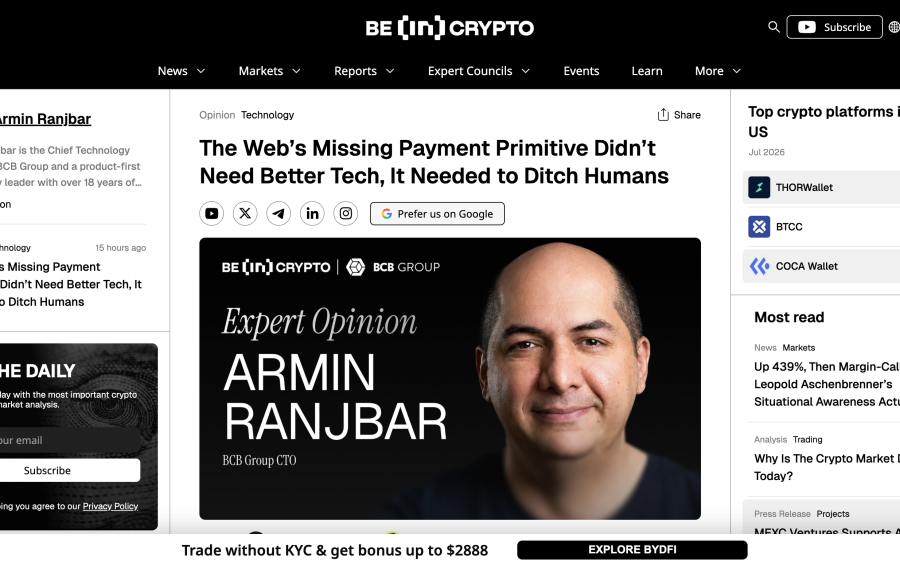
Beyond the Hype: Why x402 and Agentic Commerce Fix the 30-Year Micropayment Problem
READ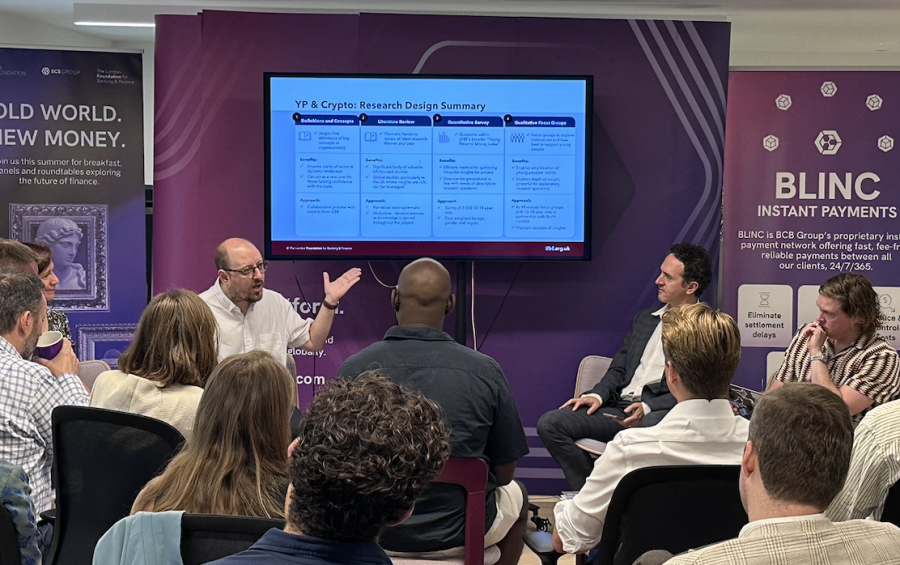
From awareness to understanding: unpacking Key Themes in Financial Capability: Young People and Cryptocurrency
READ
BCB Group CTO Armin Ranjbar on finding the right unit of progress
READ
Young People and Cryptocurrency: What the Next Generation Really Thinks About Digital Finance
READ