
BLINC Adoption Roadmap for Treasury Teams
Modernising treasury operations for scalable cross-border growth
As remittance providers and cross-border payment firms expand globally, their treasury operations become significantly more complex.
Introducing additional currencies, payment corridors and banking relationships inevitably places greater demands on treasury functions, increasing the pressure on existing settlement processes.
Many treasury teams continue to manage these challenges successfully using established operating models. As organisations enter new corridors, they often introduce additional operational processes to ensure existing systems continue to perform reliably. However, as transaction volumes increase and international operations become more complex, manual processes, fragmented liquidity and limited treasury visibility can begin to constrain future growth.
Modernising treasury operations does not require a complete overhaul of existing models. Instead, organisations can progressively enhance their settlement infrastructure, enabling them to operate more efficiently while minimising disruption and supporting continued international expansion.
The roadmap below outlines five typical stages organisations move through as they modernise their treasury operations.
Stage 1: Managing today’s settlement operations
Treasury teams need operating models that support both their current requirements and future growth. However, many organisations continue to rely on a large number of correspondent banking partners. This can create considerable operational and administrative complexity, particularly where each banking partner has corridor-specific arrangements and different settlement requirements.
While these models often perform well when transaction volumes are relatively stable, they can become increasingly difficult to manage as banking relationships expand. Prefunding requirements may increase, treasury activity can become more fragmented and reconciliation workloads often grow as organisations manage a larger number of accounts, counterparties and settlement processes.
These challenges do not necessarily indicate that existing infrastructure has failed. Rather, they often suggest that it may not have been designed to support the increasing complexity associated with larger international payment operations.
Key priority
Maintain operational control while preparing for future growth.
Stage 2: Reducing operational complexity
Growth inevitably leads to greater operational complexity.
When treasury teams enter new corridors, they will need to establish new counterparty relationships, work with local banking partners and adapt to different settlement processes. Over time, these requirements can create fragmented operating models that depend increasingly on manual intervention.
Treasury teams may spend more time managing exceptions, reconciling transactions and monitoring liquidity across multiple accounts.
As operational complexity increases, reducing reliance on manual processes becomes more important.
Key considerations
- Can settlement processes be simplified?
- Are reconciliation activities becoming too resource intensive?
- Are treasury teams spending more time managing operations than improving them?
The objective is to establish more consistent, efficient and scalable treasury processes.
Stage 3: Improving liquidity visibility
Liquidity management becomes increasingly important as organisations expand across multiple currencies and jurisdictions.
Without clear visibility of available funds, treasury teams may rely on larger liquidity buffers or maintain capital across numerous accounts to ensure payment obligations can always be met.
Improved visibility also enables organisations to make more informed treasury decisions by providing an accurate, up-to-date view of payment activity and liquidity positions. This can help organisations identify potential issues faster, deploy working capital more efficiently and support better operational decision-making.
Modern settlement infrastructure can help treasury teams maintain greater oversight of payment activity, settlement status and liquidity positions across their operations.
Key priority
Improve liquidity visibility while reducing unnecessary operational friction.
Stage 4: Building connected treasury infrastructure
As treasury operations mature, organisations need to focus on how different parts of their payment infrastructure work together and complement one another.
Rather than viewing payment operations as a collection of individual banking relationships or settlement processes, leading organisations begin building more connected operating models that support greater flexibility and resilience.
Network-based settlement infrastructure, such as BLINC, can support this evolution by enabling more efficient movement of funds between participants while improving settlement predictability and operational visibility.
This can help strengthen the overall settlement architecture, allowing treasury teams to operate more efficiently as the organisation grows.
The characteristics of a mature treasury model typically look like this:
- Greater visibility across payment activity
- More efficient liquidity management
- Reduced operational complexity
- Predictable settlement processes
- Increased resilience across multiple markets
Stage 5: Operating a scalable treasury function
Modern treasury functions are expected to play a much more strategic role in organisational growth than they have historically. Today, their responsibilities extend well beyond simply settling payments.
Treasury teams are increasingly expected to support commercial growth by helping their organisations launch into new markets, manage liquidity efficiently and respond confidently to changing customer, market and regulatory expectations.
As transaction volumes continue to increase, scalable settlement infrastructure can become an important competitive advantage.
Treasury teams with access to predictable settlement, improved liquidity flexibility and connected payment infrastructure are often better positioned to support long-term international expansion while maintaining operational resilience.
The objective is not simply faster payments. It is building a treasury operating model that can continue supporting growth predictably, efficiently and at scale without introducing unnecessary operational complexity.
Where BLINC fits in
Treasury modernisation is rarely achieved through a single technology implementation. It is typically an ongoing, incremental process of improving operational efficiency, strengthening liquidity management and enhancing settlement capabilities as organisational requirements evolve.
BLINC is designed to support this journey by providing institutional settlement infrastructure that complements existing payment operations rather than replacing them. It helps organisations simplify settlement activity, improve liquidity flexibility and build more connected treasury operations.
Treasury infrastructure has become much more than a back-office consideration. As organisations expand into new markets, the ability to settle payments predictably, manage liquidity efficiently and support continued growth is becoming an increasingly important competitive advantage. The appropriate level of treasury modernisation will of course vary between organisations, depending on their transaction volumes, international footprint and operational requirements. However, the ultimate objective is to adopt infrastructure that supports future growth without introducing any unnecessary complexity.

Related Insights

How Banks Are Navigating the Correspondent Banking Transition in 2026
READ
Beyond the Hype: Why x402 and Agentic Commerce Fix the 30-Year Micropayment Problem
READ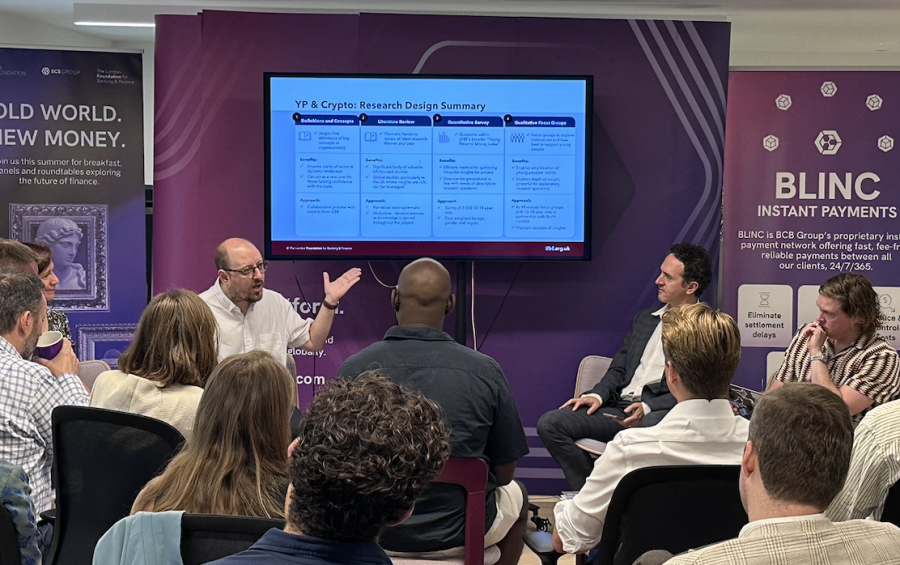
From awareness to understanding: unpacking Key Themes in Financial Capability: Young People and Cryptocurrency
READ
BCB Group CTO Armin Ranjbar on finding the right unit of progress
READ
Young People and Cryptocurrency: What the Next Generation Really Thinks About Digital Finance
READ
What is IBAN discrimination and why does it still matter in Europe?
READ
What are agentic payments and why do they matter?
READ