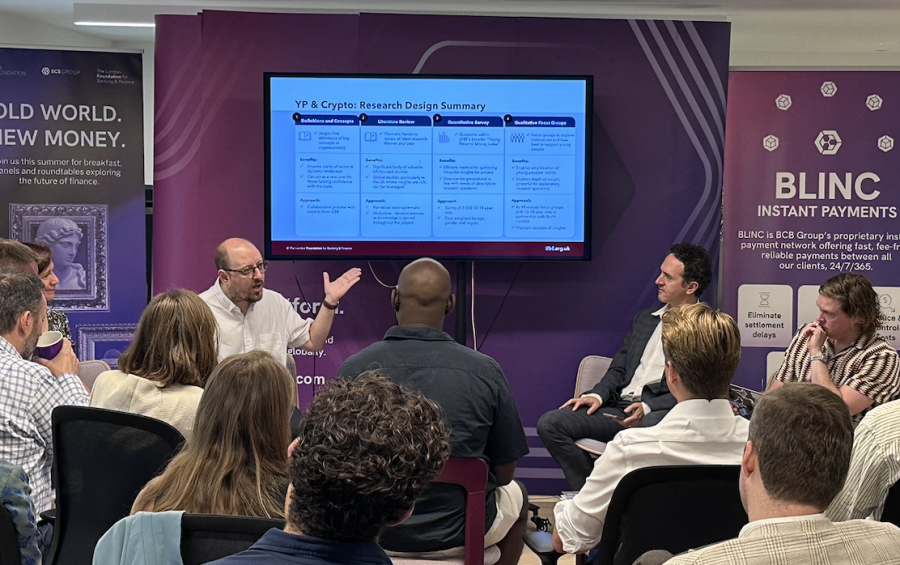
From awareness to understanding: unpacking Key Themes in Financial Capability: Young People and Cryptocurrency
Today’s panel featuring Dr George Hoare, James Newell, Janet du Chenne and Brian McGleenon explored what that means for education, trust, and the future of financial infrastructure.
On Wednesday 22nd July BCB Group took part in a panel discussing the Key Themes in Financial Capability: Young People and Cryptocurrency, new research from The London Foundation for Banking & Finance (LFBF), commissioned by the GSR Foundation and delivered with London Youth. The study combined a survey of 2,000 UK 15–18-year-olds with in-depth focus groups, and it paints the clearest picture yet of how the next generation is encountering digital assets.
The Findings
The numbers tell a story of engagement running ahead of infrastructure. Around 80% of young people have heard of cryptocurrency, and 27% of 15–18-year-olds have owned or used a crypto-related product — spanning exchanges, wallets, Bitcoin and Ethereum, NFTs and gaming tokens. For a cohort not yet out of school, that is not a fringe behaviour. It is a market signal.
Yet fewer than a quarter feel confident they understand how cryptocurrencies work. The research surfaces a confidence paradox: respondents who had received Free School Meals reported more than twice the confidence of their peers (33% vs 14%), despite wider evidence of structural inequalities in financial capability — a reminder that self-belief and understanding are not the same thing, and that the groups most exposed to risk are often the least supported.
What the research firmly rejects is the caricature of the naive teenage speculator. Focus group participants were pointedly sceptical of influencer wealth narratives and alert to volatility, scams and the absence of consumer protections. Their motivations are rational: in an economy defined by housing unaffordability and constrained prospects, digital assets are perceived as one of the few accessible routes to financial progress.
Most striking of all: the distrust doesn’t stop at crypto. Young people described banks as jargon-heavy, inaccessible and indifferent — “they don’t care, I don’t think” as one participant put it. Only 2% cite banks as their primary source of financial information. The trust gap is industry-wide.
Three key themes that stood out:
Friction cuts both ways. This is a generation that has never queued in a branch or written a cheque — money has always been a tap on a phone. Crypto’s early user experience was anything but frictionless, which makes its adoption by young people all the more telling. But the panel also challenged the assumption that friction is always the enemy: when spending is entirely dematerialised, some deliberate friction may be exactly what healthy financial behaviour requires.
Trust was broken — and is being rebuilt slowly. The collapses of FTX and Celsius left a mark on the cohort who watched them unfold in their mid-teens. The result is a more cautious, more discerning generation entering the space — one that wants transparency and credibility before capital. The panel was clear that this is not a barrier to the industry but a standard to meet.
Convergence is happening regardless. Institutional adoption is no longer hypothetical: banks are building digital asset desks, institutions are using DeFi rails for settlement efficiency, and tokenised assets are moving toward retail. The panel looked ahead to the combination many see as transformative — stablecoins, smart contracts and agentic payments, with AI agents transacting autonomously on programmable rails. The open questions are regulatory: closing the legal gap between a token and its underlying asset, and ensuring the infrastructure earns the trust the technology promises.
There was also a note of caution against convergence erasing what makes the technology valuable. The ability to transact without traditional gatekeepers remains profoundly important for those excluded from the banking system — a benefit worth protecting as institutions move in.
The future
The report lands on three recommendations: modernise financial education curricula to reflect the products young people actually encounter; explore learning methods suited to digital finance, from carefully designed gamification to expert-led, face-to-face formats; and reconnect young people with a financial services industry they currently feel dismissed by.
For those of us building the infrastructure layer, the message is sharper still. The next generation is already forming its view of money — with or without us. The institutions that win their trust will be the ones that pair regulated, resilient rails with communication that treats young people as the market participants they already are.
The full report is available from LFBF





Related Insights

BCB Group CTO Armin Ranjbar on finding the right unit of progress
READ
Young People and Cryptocurrency: What the Next Generation Really Thinks About Digital Finance
READ
What is IBAN discrimination and why does it still matter in Europe?
READ
What are agentic payments and why do they matter?
READ
BCB Group is shortlisted for four awards at the Women in Tech Employer Awards 2026
READ
Understanding modern remittance infrastructure
READ
How modern settlement infrastructure helped BLINC gain dominance
READ