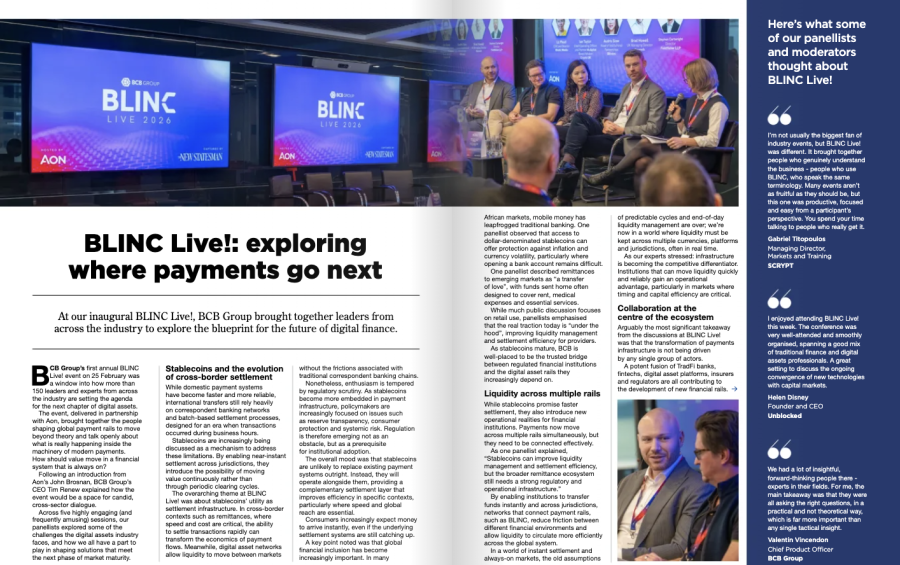
BLINC Live!: Exploring Where Payments Go Next
At our inaugural BLINC Live! BCB Group brought together leaders from across the industry to explore the blueprint for the future of digital finance.
BCB Group’s first annual BLINC Live! Event on 25 February was a window into how more than 150 leaders and experts from across the industry are setting the agenda for the next chapter of digital assets.
The event, delivered in partnership with Aon, brought together the people shaping global payment rails to move beyond theory and talk openly about what is really happening inside the machinery of modern payments. How should value move in a financial system that is always on?
Following an introduction from Aon’s John Brosnan, BCB Group CEO Tim Renew explained how the event would be a space for candid, cross-sector dialogue.
Across five highly engaging (and frequently amusing) sessions, our panellists explored some of the challenges the digital assets industry faces, and how we all have a part to play in shaping solutions that meet the next phase of market maturity.
Stablecoins and the evolution of cross-border settlement
While domestic payment systems have become faster and more reliable, international transfers still rely heavily on correspondent banking networks and batch-based settlement processes, designed for an era when transactions occurred during business hours.
Stablecoins are increasingly being discussed as a mechanism to address these limitations. By enabling near-instant settlement across jurisdictions, they introduce the possibility of moving value continuously rather than through periodic clearing cycles.
The overarching theme at BLINC Live! was about stablecoins’ utility as settlement infrastructure. In cross-border contexts such as remittances, where speed and cost are critical, the ability to settle transactions rapidly can transform the economics of payment flows. Meanwhile, digital asset networks allow liquidity to move between markets without the frictions associated with traditional correspondent banking chains.
Nonetheless, enthusiasm is tempered by regulatory scrutiny. As stablecoins become more embedded in payment infrastructure, policymakers are increasingly focused on issues such as reserve transparency, consumer protection and systemic risk. Regulation is therefore emerging not as an obstacle, but as a prerequisite for institutional adoption.
The overall mood was that stablecoins are unlikely to replace existing payment systems outright. Instead, they will operate alongside them, providing a complementary settlement layer that improves efficiency in specific contexts, particularly where speed and global reach are essential.
Consumers increasingly expect money to arrive instantly, even if the underlying settlement systems are still catching up.
A key point noted was that global financial inclusion has become increasingly important. In many African markets, mobile money has leapfrogged traditional banking. One panellist observed that access to dollar-denominated stablecoins can offer protection against inflation and currency volatility, particularly where opening a bank account remains difficult.
One panellist described remittances to emerging markets as “a transfer of love”, with funds sent home often designed to cover rent, medical expenses and essential services.
While much public discussion focuses on retail use, panellists emphasised that the real traction today is “under the hood”, improving liquidity management and settlement efficiency for providers.
As stablecoins mature, BCB is well-placed to be the trusted bridge between regulated financial institutions and the digital asset rails they increasingly depend on.
Liquidity across multiple rails
While stablecoins promise faster settlement, they also introduce new operational realities for financial institutions. Payments now move across multiple rails simultaneously, but they need to be connected effectively.
As one panellist explained, “Stablecoins can improve liquidity management and settlement efficiency, but the broader remittance ecosystem still needs a strong regulatory and operational infrastructure.”
By enabling institutions to transfer funds instantly and across jurisdictions, networks that connect payment rails, such as BLINC reduce friction between different financial environments and allow liquidity to circulate more efficiently across the global system.
In a world of instant settlement and always‑on markets, the old assumptions of predictable cycles and end‑of‑day liquidity management are over; we’re now in a world where liquidity must be kept across multiple currencies, platforms and jurisdictions, often in real time.
As our experts stressed; infrastructure is becoming the competitive differentiator. Institutions that can move liquidity quickly and reliably gain an operational advantage, particularly in markets where timing and capital efficiency are critical.
Collaboration at the centre of the ecosystem
Arguably the most significant takeaway from the discussions at BLINC Live! was that the transformation of payments infrastructure is not being driven by any single group of actors.
A potent fusion of tradfi banks, fintechs, digital asset platforms, insurers and regulators are all contributing to the development of new financial rails. Perhaps this highlights a welcome, shared recognition that successful modern payment systems need to operate across multiple technological environments.
That’s why infrastructure providers such as BCB Group occupy a particularly important position within this ecosystem, with platforms that can bridge fiat and digital currencies, facilitate cross-border transfers and support real-time settlement across multiple jurisdictions.
By connecting traditional banking networks with digital asset markets, they enable institutions to interact with new technologies without abandoning the safeguards of regulated financial infrastructure.
Meanwhile, collaboration between industry participants is helping to establish common standards for governance, compliance and operational resilience.
The evolving role of the CFO
Another notable theme throughout the event was the shifting role of financial leadership within digital asset markets.
It used to be the provenance of specialists only, but these days the responsibility for managing digital asset exposure increasingly sits with chief financial officers and senior treasury leaders: despite it being “every CFO’s worst nightmare (sic),” our panel agreed that “ignoring crypto is not an option”.
The CFOs’ role is now to evaluate how payment networks, settlement systems and liquidity platforms can improve operational efficiency while maintaining robust controls.
Effectively, this leads to closer collaboration between financial institutions, infrastructure providers and technology firms, a key factor in building a growing, resilient ecosystem.
Keeping digital assets insured
As the ecosystem expands, so too does the range of risks to consider. While market volatility is an ever-present concern, there are potential operational risks in cybersecurity, custody safeguards and counterparty risk.
Digital assets thus need flexible insurance policies to match the evolving market. One panellist said: “We are dealing with a very slow-moving beast versus a very dynamic, fast-moving market.”
Perhaps the insurance market is beginning to catch up with the rapid growth of digital assets, as institutions explore how to protect a sector defined by new technologies and unfamiliar risks.
Traditional coverage such as cybercrime and directors’ and officers’ liability is becoming increasingly important for crypto firms, while users are looking for embedded protection around treasury holdings and digital assets.
However, insurers must adapt to a market that is evolving faster than the industry’s usual risk models allow.
AI is forcing firms to rethink operational resilience
Our experts painted a stark picture that the era of “industrialised deception” is here. Fraud is no longer a cottage industry; it is professionalised, scalable and increasingly automated – a “rational and ROI-driven, scalable, automated and professionalised industry”, as one panellist put it. AI enables criminals to generate synthetic identities, deepfake audio and video, and highly personalised social engineering attacks.
The crypto sector alone has seen billions in losses linked to AI-enabled fraud. But the implications extend far beyond digital assets. Any institution operating across multiple payment rails is exposed.
As a result, it’s increasingly crucial to embed a regulatory-first approach in organisational culture, beyond just compliance. The solution for firms? “Fight AI with AI”, as one panellist said, deploying machine learning for anomaly detection, behavioural analytics and real-time monitoring. Nonetheless, technology alone won’t be enough – there will be an equally key role to play for governance and operational discipline.
Looking ahead: the future of digital asset infrastructure
If there was one unifying conclusion among our experts, it was that the firms that will succeed will be those capable of bridging traditional finance with digital asset innovation.
BCB Group is already ahead of the game in that department, with BLINC providing fee-free instant settlement 24/7/365 across multiple currencies within its closed-loop network, giving institutions the visibility and control they need in a multi-rail world. Our regulatory-first approach aligns with the direction of travel across global jurisdictions.
The direction of travel is speeding up. Payments are moving towards a model that is faster, more interconnected and increasingly global in nature, while stablecoins are being evaluated as settlement tools rather than speculative instruments.
Meanwhile, treasury teams are adapting to continuous liquidity management, with regulators and insurers establishing frameworks that support responsible growth such as the crypto regulatory regime.
While some experts at BLINC Live! questioned who would ultimately ‘win’ between banks and digital asset firms, there was general agreement that the future is likely to be hybrid forms of remittance rails rather than adversarial. Ultimately, consumers will care less about the underlying rails and more about speed, cost and reliability.
We’ll be back!
Before delegates began networking, BCB Group’s co-founder and President Oliver Tonkin rounded off the event by thanking all panellists and the audience for helping set the agenda for the next chapter of digital assets.
A big thank you to all the speakers, panellists, moderators and delegates who made our inaugural BLINC Live! so memorable.
The success of BLINC Live! has left us hungry for more opportunities to gather digital finance leaders to engage with peers, regulators and innovators on an equal footing.
The future payments ecosystem will not be defined by a single technology or network. Instead, it will emerge from the interaction of multiple systems working together to move value more efficiently across the global economy. BCB Group will continue to build the connective tissue that makes this new world work.
And BLINC Live! will be a key part of that too. We look forward to seeing you on 10 March 2027 for BLINC Live! 2027, to be part of the conversation that will define the next decade of global payments. RSVP
Read the full magazine here

Related Insights

BLINC Adoption Roadmap for Treasury Teams
READ
How Banks Are Navigating the Correspondent Banking Transition in 2026
READ
Beyond the Hype: Why x402 and Agentic Commerce Fix the 30-Year Micropayment Problem
READ
From awareness to understanding: unpacking Key Themes in Financial Capability: Young People and Cryptocurrency
READ
BCB Group CTO Armin Ranjbar on finding the right unit of progress
READ
Young People and Cryptocurrency: What the Next Generation Really Thinks About Digital Finance
READ
What is IBAN discrimination and why does it still matter in Europe?
READ