Introduction
How will modern infrastructure shape the next decade of cross-border payments?
Cross-border remittances have become significantly faster and more accessible over the past decade. These developments have helped strengthen the infrastructure that enables individuals, families and businesses to move money across borders with greater speed, reliability and certainty.

These improvements would not have been possible without three important developments. The first is greater connectivity between banks, payment institutions and liquidity providers, which enables organisations to move funds more efficiently across an increasingly interconnected financial ecosystem. The second is advances in payment technology, including stablecoins, real-time payment schemes and programmable forms of digital money, which are expanding the range of settlement options available to institutions. The third is the development of more mature regulatory and technical frameworks, including the EU’s Markets in Crypto-Assets Regulation (MiCA) and the continued adoption of the ISO 20022 financial messaging standard, which have provided greater consistency and interoperability as the market continues to evolve.
While these new technologies are already influencing how institutions approach settlement, liquidity and treasury operations, on their own, they are unlikely to determine which organisations ultimately succeed in the next 10 years.
Instead, long-term competitiveness will become more dependent on how effectively organisations combine new technologies with resilient operating models, modern treasury capabilities and increasingly connected financial infrastructure.
This report will examine how remittance infrastructure is expected to evolve between now and 2036. It explores the operational challenges providers are likely to encounter, the characteristics of modern remittance infrastructure, the practical considerations involved in infrastructure modernisation, and the capabilities organisations need to develop now to remain competitive in the long term.
Section 1
How will remittance infrastructure evolve over the next decade?
The current challenge is that many cross-border transactions are still reliant on correspondent banking networks. While these networks continue to play an important role in global payments, they were developed for a very different operating environment from the one remittance providers are now entering.

The remittance market is now entering a new phase
Transaction volumes are increasing quickly, providers are expanding into new corridors, and customer expectations continue to rise. As a result, the infrastructure that has supported remittances over the past decade may no longer be sufficient to support the next phase of the industry’s development.
More than 20 years ago, ISO 20022 helped to standardise financial messaging by creating a common framework for cross-border payments and a pathway towards more integrated financial services. While it was a major step forward, it did not deliver the level of interoperability that many financial institutions had expected. For example, some payment market infrastructures have yet to fully adopt ISO 20022 for their cross-border payments, which means they are still reliant on translation services.
Moving towards a more connected infrastructure model
The next stage of infrastructure development is therefore likely to focus less on standardisation and more on improving connectivity between payment networks, financial institutions and settlement partners.

Institutions are now increasingly exploring how correspondent banking networks, domestic instant-payment schemes, network-based settlement and stablecoin-enabled settlement can complement one another within a more integrated ecosystem. The industry has spent many years searching for a single solution to cross-border payments, but that outcome now appears increasingly unlikely. The more realistic direction of travel is one in which different settlement models coexist, each serving different operational requirements.
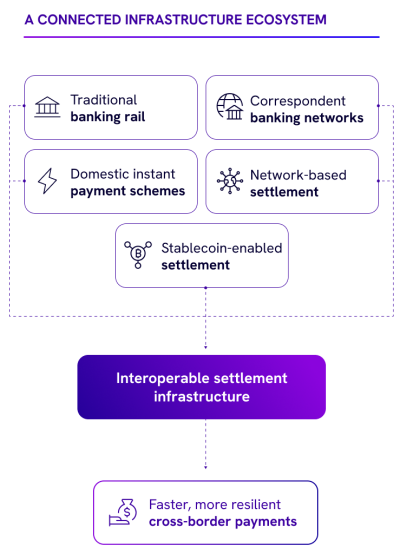
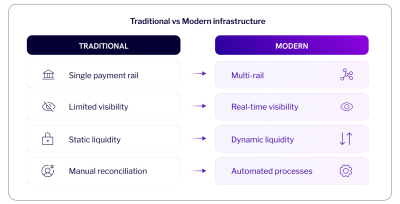
Equally important will be the ability to move seamlessly between traditional fiat payment infrastructure and digital settlement networks. As multi-rail operating models are adopted more widely, the boundaries between these environments should become primarily operational rather than technological.
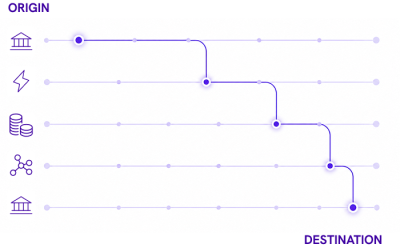
This is why the future of cross-border payments is likely to resemble a modern transport network. Just as motorways, regional roads, bypasses and tunnels each perform different functions within the same transport system, future payment infrastructure is likely to comprise multiple interconnected settlement models, each optimised for different corridors, currencies and operational requirements.
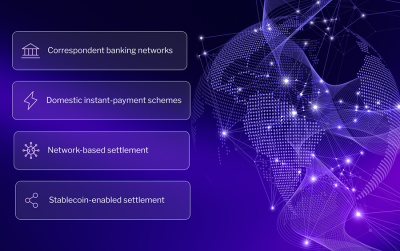
The future of remittance is multi-rail
Organisations that can coordinate liquidity, treasury and settlement effectively across multiple networks will be better positioned to sustain future growth while maintaining operational resilience.
One of the most significant benefits of this more connected operating model is improved access to operational data. As payment volumes increase, treasury teams require more accurate, real-time information about payment status, liquidity positions and settlement activity. More accurate payment data can improve forecasting, reconciliation and operational decision-making while reducing the manual effort associated with fragmented reporting across multiple banking relationships.
Alongside these broader institutional developments, attitudes towards stablecoins are also changing. Many organisations are moving beyond basic questions about legitimacy and beginning to assess how stablecoin-enabled settlement could be incorporated into existing treasury and payment operations. Over the next decade, the emphasis should shift more towards implementation, governance and integration rather than education alone.
Section 2
What operational challenges will shape the next generation of cross-border payments?
Growth will expose operational vulnerabilities
Growth often exposes limitations that were less visible at lower transaction volumes. As corridors expand and customers expect faster, more predictable settlement, infrastructure that previously appeared sufficient can become increasingly difficult to manage. Manual workarounds, fragmented liquidity and reliance on individual banking relationships all become more challenging as organisations scale.

Liquidity management will become more complex
Many remittance providers already manage liquidity across an expanding network of currencies, jurisdictions and banking relationships. As transaction volumes increase, that challenge becomes considerably more demanding. Capital needs to be available in the right place at the right time while supporting multiple payment corridors, settlement windows and customer requirements. To manage this uncertainty, many providers maintain liquidity buffers and prefund multiple payment corridors to ensure transactions can continue without interruption. They may need to maintain fairly significant balances across banking, payment and liquidity partners to ensure transactions can be completed on time. While this is essential for operational continuity, it can reduce capital efficiency by leaving funds idle across multiple locations.
Infrastructure that enables faster rebalancing and more predictable settlement can release some of this trapped cash and improve working-capital flexibility. This can improve liquidity mobility considerably, allowing organisations to deploy capital with greater efficiency and reduce the amount tied up in corridor prefunding. This infrastructure also helps to reduce reconciliation delays by giving operations teams earlier confirmation that funds have been received and allocated correctly.
However, it is important to emphasise that faster settlement alone does not eliminate liquidity challenges. Many providers still face regulatory, FX and counterparty constraints that technology cannot solve.
Stablecoin-enabled settlement will become an operational capability
Stablecoin-enabled settlement is increasingly being evaluated as one way of addressing some of these operational challenges – often within a supporting capacity. Rather than replacing existing banking infrastructure, stablecoins have the potential to complement traditional payment rails by supporting faster settlement, extending settlement availability beyond conventional banking hours and improving the movement of liquidity between counterparties.
Many of the operational benefits may not be immediately visible, but they can significantly improve the efficiency of the treasury and settlement processes that sit behind every remittance transaction. These include faster treasury rebalancing, more flexible funding models and reduced settlement delays, all of which can improve capital efficiency without fundamentally changing the customer-facing payment experience.
Treasury visibility will need to improve
Ten years ago, treasury’s role in many remittance businesses was largely operational. That is changing, as treasury teams are increasingly expected to play a greater role in influencing liquidity strategy, expansion planning and capital efficiency.
As organisations expand internationally, they require greater visibility over funding positions, liquidity availability and settlement activity across multiple markets. Every additional currency, banking relationship and payment corridor introduces another layer of operational complexity. Coordinating these activities efficiently is becoming an increasingly important part of supporting long-term growth.
Modernisation can also significantly reduce reliance on manual tasks. As settlement becomes more predictable and payment data becomes richer, treasury teams can automate a greater proportion of funding, monitoring and reconciliation activities, allowing specialists to focus more on liquidity optimisation and strategic planning.
Predictable settlement will become a new baseline requirement
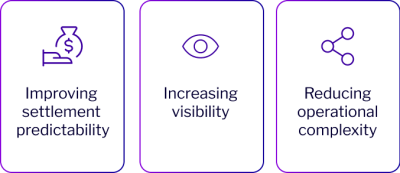
Few remittance providers rely on a single settlement mechanism. Most operate across multiple banking partners, clearing systems and payment rails, each with its own operating hours, settlement windows and local requirements. Managing these different arrangements efficiently becomes more challenging as organisations scale. Improving settlement predictability, increasing visibility and reducing operational complexity are therefore becoming increasingly important priorities.
Scaling successfully will depend on navigating regulatory complexity
Expanding into a new payment corridor involves much more than connecting to another settlement rail. Every market introduces its own regulatory expectations, local banking relationships and compliance obligations, all of which need to be integrated into existing operating models. The cumulative impact of this complexity can become significant as organisations grow. Building scalable operational processes is therefore just as important as entering new markets.
Operational resilience and interoperability will be non-negotiable
Reliable payment operations depend on more than processing transactions successfully. Organisations also need confidence that payments can continue to flow when banking partners, settlement routes or local payment infrastructure experience disruption. That requires redundancy, contingency planning and greater operational flexibility. Many institutions are also beginning to think beyond resilience towards anti-fragility: designing infrastructure that not only withstands periods of volatility, but is capable of adapting to changing market conditions with greater speed and flexibility.
As remittance providers continue to expand, this combination of resilience and adaptability will become even more important to maintaining predictable settlement and consistent service levels.
Many institutions already operate across a growing mix of correspondent banking networks, domestic payment schemes, APIs and emerging digital settlement mechanisms. Connecting these different systems effectively is becoming an important operational capability. Common messaging standards can help, but they are only one part of the solution. Organisations also need high-quality payment data, integrated operational processes and greater visibility across their settlement infrastructure in order to coordinate increasingly complex payment flows effectively.
Infrastructure transformation will need to be planned carefully
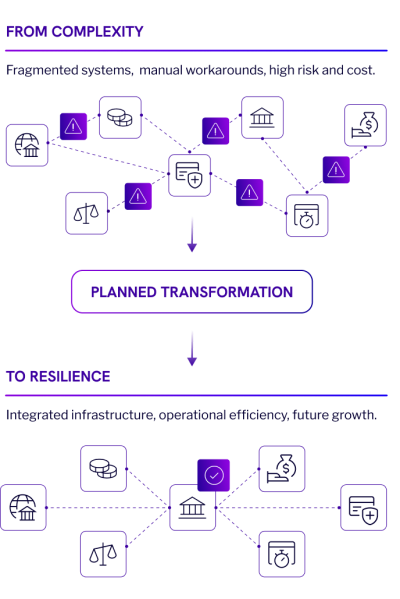
Because of the operational complexity involved, modernising payment infrastructure is rarely straightforward. While there may already be internal buy-in for change, the real challenge is introducing it without disrupting the services customers already rely on.
Organisations can introduce new settlement capabilities incrementally while maintaining existing payment services and meeting growing customer expectations. This requires careful planning, phased implementation and close coordination across operational, treasury and compliance teams to minimise disruption. Delaying this modernisation process, however, also carries greater risks as transaction volumes, regulatory requirements and international expansion continue to place greater demands on the existing infrastructure.
Section 3
Why are predictable settlement, modern infrastructure and operational resilience becoming competitive advantages?
1. Predictable settlement supports better treasury decisions
Treasury teams increasingly depend on knowing when funds will become available. Delayed or uncertain settlement can make liquidity planning more difficult, tying up capital that could otherwise be deployed elsewhere within the business. As remittance providers continue to scale internationally, greater settlement predictability enables treasury teams to make more informed funding decisions, improve cash visibility and respond more confidently to changing payment flows.
2. Interoperability supports operational flexibility
Modern remittance providers rarely operate through a single banking relationship or payment rail. Instead, they increasingly need to coordinate domestic payment schemes, correspondent banking networks and emerging settlement models across multiple jurisdictions. Infrastructure that can connect these different systems more effectively helps reduce operational friction while allowing organisations to adapt as payment ecosystems continue to evolve.
3. Liquidity becomes a strategic capability
As organisations expand internationally, liquidity management becomes increasingly dynamic. Treasury teams need visibility over funding positions across multiple currencies, while also ensuring capital can be redeployed efficiently as transactions settle. Shorter and more predictable settlement cycles can improve liquidity mobility, reducing the amount of capital tied up in prefunding arrangements and allowing organisations to support continued growth more efficiently.
4. Operational resilience enables sustainable growth
Growth naturally increases operational complexity. More payment corridors, banking relationships and regulatory requirements create additional dependencies that organisations must manage carefully. Building resilience through contingency planning, redundant settlement routes and diversified banking relationships helps reduce operational risk while supporting more reliable payment execution across international markets.
5. Connected networks become increasingly valuable
The value of financial infrastructure increasingly extends beyond the movement of individual payments. As more institutions connect through shared settlement networks, organisations benefit from greater connectivity, broader liquidity access and more efficient interaction with counterparties. The value of a settlement network increasingly depends more heavily on the diversity of institutions connected to it, including banking partners, FX providers, liquidity providers and payout specialists. These network effects can improve operational efficiency over time, helping remittance providers scale while maintaining predictable and reliable settlement.
Section 4
Navigating the transition to modern infrastructure
The importance of consistent, incremental infrastructure modernisation
Replacing payment infrastructure is rarely a single event. It is usually a gradual process that unfolds over several years as organisations respond to changing customer expectations, regulatory requirements and commercial priorities. For many remittance providers, a phased approach offers the most practical path forward, allowing new capabilities to be introduced while protecting the stability of existing operations. Small, well-managed improvements can gradually reduce technical debt, simplify treasury processes and prepare the business for future growth without creating unnecessary disruption.
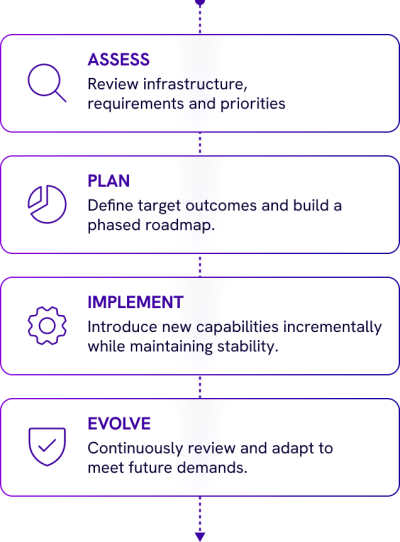
The speed of change will require providers to review their infrastructure continuously. Organisations that assess new settlement models, regulatory developments and customer requirements early will be better placed to adapt progressively, avoiding the need for more disruptive transformation later.
Building a multi-rail operating model
The payments landscape is becoming more diverse rather than more uniform. Traditional correspondent banking, domestic instant payment schemes, stablecoin-enabled settlement and network-based infrastructure are all likely to coexist for the foreseeable future, with different rails serving different operational requirements. As a result, remittance providers increasingly need operating models that can support multiple settlement methods while maintaining consistent visibility, governance and control. The objective is flexibility. Organisations should be able to select the most appropriate settlement route for each payment without introducing unnecessary operational complexity.
Preparing the wider organisation for change, not just new technologies
Successful infrastructure modernisation extends well beyond technology implementation. Treasury teams may need to adopt more dynamic liquidity management practices, while compliance, risk and operations functions must develop new processes to support increasingly real-time payment environments. Governance becomes equally important. Institutions should review funding models, counterparty arrangements, contingency planning and operational controls before introducing new settlement capabilities at scale. The strongest operating models evolve together, rather than one function changing in isolation.
The operational cost of standing still
Maintaining familiar infrastructure often appears to be the least disruptive option. In practice, however, delaying investment can allow operational complexity to accumulate over time. As transaction volumes increase, corridors expand and regulatory expectations become more demanding, legacy processes frequently require greater levels of manual intervention, liquidity management and operational oversight. Customer expectations continue to evolve as well. Organisations that modernise progressively are generally better positioned to respond to these changes, while those that postpone investment may eventually face larger transformation programmes, greater operational risk and fewer strategic options.
As infrastructure becomes more complex, providers are likely to adopt a more solution-led approach. Remittance firms will increasingly evaluate partners according to the specific treasury, settlement and liquidity challenges they can address across different corridors. This should place greater emphasis on consultative relationships, operational expertise and the ability to configure infrastructure around distinct business models.
Section 5
Preparing for the remittance operating model of 2036
Remittance infrastructure will become increasingly multi-rail
By 2036, remittance providers are likely to operate across a broader mix of payment and settlement networks. Correspondent banking, domestic instant-payment schemes, stablecoin-enabled settlement and network-based infrastructure will continue to coexist. Different routes will suit different currencies, jurisdictions and operational requirements.
The strongest providers will be able to move between these rails efficiently while maintaining consistent oversight across the full payment lifecycle. That flexibility should become even more important as payment ecosystems continue to fragment and evolve.
Internal treasury movement will become a greater priority
A customer-facing remittance may appear instantaneous. Behind that transaction, however, funds can still take several days to move between banking partners, FX providers and payout institutions.
Much of the future infrastructure opportunity therefore sits within this business-to-business layer. Faster rebalancing between an organisation’s own accounts, liquidity providers and settlement partners can improve cash-flow management, reduce delays and simplify the treasury processes that support each customer transaction.
Liquidity will be funded closer to the point of need
Many remittance providers currently maintain balances with multiple partners across the world to ensure funds are available when required. This supports continuity, but it can also leave significant amounts of capital sitting idle.
More predictable settlement should allow institutions to move towards just-in-time funding. Corridor floats may gradually become smaller, enabling treasury teams to deploy available liquidity more efficiently elsewhere in the business.
Stablecoins will support new liquidity and settlement models
Stablecoins should become a more established part of the institutional remittance ecosystem. Their value will be particularly clear where organisations need faster cross-border settlement, 24/7 availability or greater flexibility over when funds are converted into local currency.
Stablecoin-enabled infrastructure may also change how some remittance flows are completed. In markets where access to conventional bank accounts is limited or local currencies are volatile, recipients may increasingly hold dollar-denominated digital balances before converting only the amount needed for local use. This could reduce the immediate dependence on local-currency payout while creating new operational requirements around custody, access, liquidity and consumer protection.
Connectivity will become a more valuable infrastructure capability
Future remittance infrastructure will increasingly connect providers more closely with FX brokers, liquidity providers, banking partners and final-mile payout networks. Few institutions will have the resources or commercial need to build every capability internally.
A connected ecosystem can provide access to broader settlement options while reducing the burden of maintaining numerous bilateral relationships. This should allow providers to expand more efficiently as their corridor coverage grows.
Network effects can create more operational value for participants
Settlement networks become more valuable as relevant participants join them – but, in practice, the quality of participants often matters as much as their number. Bringing remittance providers, banking partners, FX firms, liquidity providers and payout specialists into the same ecosystem can shorten settlement chains, simplify onboarding and improve access to counterparties.
Wider participation may also strengthen liquidity and increase the network’s usefulness across more corridors. Over time, this can become self-reinforcing as institutions seek access to counterparties already connected to the ecosystem. Counterparty risk will still need to be assessed carefully, regardless of network size.
Regional infrastructure will remain fragmented
Global remittance infrastructure will not develop uniformly. Countries will continue to operate through different regulatory frameworks, payment habits and levels of banking access. For example, a provider entering Kenya is likely to encounter a very different operating environment from one entering Germany or Mexico. Mobile-money adoption, banking penetration and payout preferences vary significantly.
Africa illustrates this clearly. Some markets are highly mobile-money-led, while others depend more heavily on traditional banking infrastructure. Providers will need flexible market-entry and partnership strategies rather than assuming one operating model can be applied across every jurisdiction.
Partnership models will become more important
Obtaining licences, building local rails and establishing direct banking relationships in every market requires considerable time and investment. Providers will therefore need to decide where deeper infrastructure development creates a meaningful strategic advantage.
In other markets, partnerships may offer a faster and more efficient route to expansion. This approach can increase coverage without creating an operational footprint that becomes difficult to manage. As infrastructure becomes more specialised, providers are likely to place greater value on partners that understand their operational challenges and can help configure infrastructure around specific business models, rather than offering a single, ‘one size fits all’ solution.
Reliability will become more measurable
Broad claims about payment reliability will carry less weight as the market matures. Providers will increasingly be assessed more rigorously through practical measures such as payment success rates, adherence to service-level agreements, settlement certainty and the frequency of manual intervention.
Even modest failure rates can become costly at a large scale, as they create greater reconciliation workloads, customer-service pressures and uncertainty over liquidity positions.
Regulation will support institutional adoption
Regulatory maturity is likely to play a central role in the development of remittance and stablecoin infrastructure. Licensed institutions will need to demonstrate robust compliance, information security and risk-management capabilities when connecting traditional and digital payment systems.
As stablecoin adoption becomes more institutional, compliance will remain a fundamental design requirement. Organisations will need infrastructure that meets regulatory expectations from the outset, particularly when connecting traditional banking systems with digital settlement networks. For mid-tier providers, regulated partners may provide a more controlled route into stablecoin settlement, reducing the need to build specialist capabilities internally while preserving appropriate oversight.
Mid-tier providers will face growing pressure to modernise
Many of the largest remittance organisations are already investing in stablecoin-enabled infrastructure and modern settlement networks. The next phase of adoption is likely to extend further into the mid-market, where providers face similar pressure to improve speed, liquidity and reliability but often have fewer internal resources. Shared infrastructure and regulated partners could help these organisations modernise without absorbing the full cost and complexity of building every capability themselves.
Cost will be assessed across the entire operating model
The economics of remittance infrastructure extend well beyond transaction fees. Providers must also consider FX execution, settlement delays, idle balances, payment failures, prefunding requirements and the cost of managing multiple counterparties.
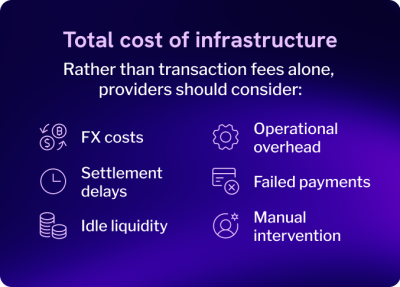
Headline pricing will remain important. Greater attention, however, is likely to be paid to the total operational value delivered by an infrastructure provider, including capital efficiency, reliability and the ability to support growth with fewer dependencies.
Conclusion
Preparing for the next era of remittance infrastructure
By 2036, remittance infrastructure is likely to be more connected, flexible and closely integrated with institutional treasury operations. Providers will increasingly coordinate traditional banking rails, domestic payment networks and stablecoin-enabled settlement through a multi-rail operating model.
Payments should also be funded closer to the point of execution, supported by broader ecosystems of banking, liquidity and payout partners. The providers best positioned to succeed will combine reliable settlement with operational flexibility, strong regulatory controls and the ability to expand without creating excessive infrastructure complexity.
The next ten years should be defined more by how effectively providers can adapt their infrastructure to the evolving market rather than simply higher transaction volumes. Competitive advantage is unlikely to be maintained by moving money faster alone. It will increasingly depend on how effectively institutions coordinate liquidity, settlement, treasury and operational decision-making across an increasingly connected financial ecosystem.